
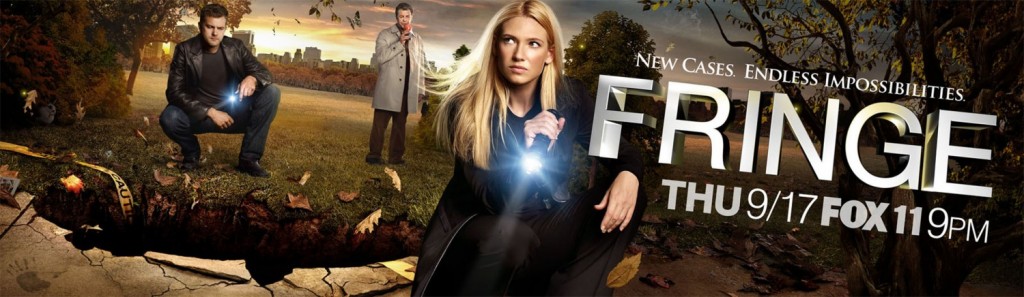
By the time Fringe arrived in 2008, J.J. Abrams was already living in the long shadow of Lost.
That is not exactly a bad place to be. Lost was one of the biggest television events of its era. It pulled people in fast, gave them mysteries to obsess over, and turned week-to-week viewing into something closer to communal detective work. For a lot of us, that was the fun. You did not just watch Lost. You chased it. You argued about it. You stared at the screen like it owed you answers.
But that intensity came with a cost. Lost also picked up a reputation for demanding too much from its audience. If you missed an episode, or drifted away for a while, the show could start to feel less like a thrilling mystery and more like homework you had fallen behind on.
Abrams clearly knew that.
When he talked about Fringe in its early days, he described it as an experiment. The idea was to build a show with an overarching story and a real endgame, but not one that required the same all-consuming devotion Lost seemed to demand. In a 2008 Hollywood Reporter interview, Abrams put it plainly: viewers were not supposed to feel like they had to watch episodes 1, 2, and 3 just to understand episode 4. That was not a tiny distinction. It was a direct response to one of the biggest complaints people had about Lost.
You can feel that choice all over early Fringe.
The first version of Fringe is much more welcoming than its later reputation sometimes suggests. Yes, there is mythology from the start. Yes, there are strange patterns, buried connections, and hints that something much bigger is happening. But the opening run is built to let viewers come in through the side door. A grotesque science experiment here. A disturbing case there. An episode built around some new piece of fringe-science weirdness, with Olivia, Peter, and Walter trying to make sense of it before things get worse.
That structure mattered. It gave Fringe a procedural skeleton, and that skeleton made the show easier to sample. You did not need a corkboard and red string on day one. You just needed to like the vibe, trust the characters, and be willing to follow the show somewhere odd.
That was the balance Abrams and company seemed to be chasing: mythology without intimidation. Serialization without scaring off casual viewers. A big sci-fi story, but one that did not immediately punish you for blinking.
In that sense, Fringe really was designed to avoid becoming another Lost.
Of course, that is only half the story.
If you keep watching Fringe, you can see the original plan slowly giving way to the show’s real identity. The case-of-the-week structure never fully disappears, but it stops being the main attraction. The mythology gets stronger. The emotional arcs deepen. The alternate-universe material becomes more central. The relationships between the main characters stop feeling like one important layer of the show and start feeling like the engine that drives it.
In other words, Fringe begins as the show that wanted to be easier than Lost, then gradually turns into the kind of show that absolutely wants your full attention.
That is not a failure. If anything, it is one of the most interesting things about the series.
There is something almost funny about the way Fringe tried to keep one foot in the accessible network-procedural lane while the rest of it kept drifting toward stranger, more serialized, more emotionally specific territory. It is like the show started out saying, “Don’t worry, this won’t be one of those,” then slowly realized it was, in fact, one of those. Just a different kind.
And that difference matters.
Lost built its hold on viewers through scale, mystery, and the constant sense that everything might connect to everything else. Fringe eventually became serialized too, but it landed in a more intimate place. Its big ideas are still big. Parallel worlds. Identity fractures. Timeline pain. Impossible science. All of that is there. But what gives Fringe its staying power is not just the mythology. It is the ache in it. The tenderness. The sadness the show keeps carrying under all the impossible science.
That is why the comparison to Lost only goes so far.
Yes, Fringe was shaped in reaction to Lost. You can hear that in Abrams’ early comments, and you can see it in the first seasons where the show works hard to stay flexible and inviting. But Fringe did not become great by permanently avoiding *Lost’s* example. It became great by learning one lesson from Lost — maybe do not make the entry barrier so high — and then following its own instincts anyway.
Those instincts eventually led it right back toward serialization. Just not the same flavor of serialization.
Fringe is less interested in trapping viewers inside a maze than in pulling them into a bond. By the time the show is fully itself, the question is not just “What is happening?” It is “What is this doing to these people?” That shift is everything. It is what keeps Fringe from feeling like a Lost rewrite or a nervous correction. The show stops defining itself by what it is trying not to be and starts becoming what it actually is.
That might be the most revealing thing here, not just about Fringe, but about Abrams as a television creator.
He did not seem to come away from Lost thinking serialization itself was the problem. He seemed to come away thinking the on-ramp mattered. Viewers needed a way in. They needed a reason to care before they were asked to commit at a near-religious level. Fringe was built with that lesson in mind. It wanted to be easier to enter, easier to follow, less punishing if you arrived late.
But television has a way of telling creators what their show really is. In a later TV Guide oral history, producer Bryan Burk admitted that even though the early plan leaned toward self-contained episodes, the show itself kept pulling toward serialization. That feels right when you watch it. Fringe could only avoid being “one of those shows” for so long, because its emotional center kept demanding more continuity, more accumulation, and more commitment.
The difference is that Fringe earned that commitment in its own voice.
So was Fringe designed to avoid becoming another Lost? In a real sense, yes. That was clearly part of the intention. The show was built with a lighter entry burden and a more open structure, especially at the start.
But it is just as true that Fringe could only avoid being another Lost for so long. Once it discovered what it cared about most, it moved toward serialization anyway. Not because it failed its original mission, but because that was where the story had real life in it.
And that is probably why Fringe still works so well.
It learned from Lost. It reacted against Lost. Then, wisely, it stopped worrying so much about Lost and became Fringe.