
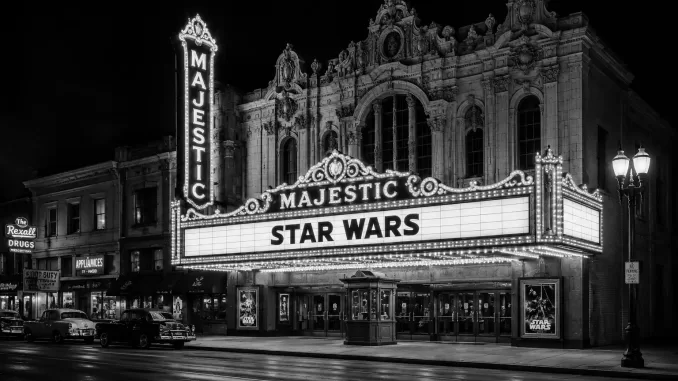
A lot of Star Wars arguments get weird because people keep demanding that the saga be something it was never built to be.
They want it to behave like an airtight prestige drama. They want every mythic flourish cross-examined. They want every choice to survive the kind of forensic scrutiny usually reserved for sacred texts, legal briefs, or fan theories posted at 2:13 in the morning by somebody who has not known peace in several years.
Meanwhile, my cousin, Dr. Nicolas, once said it better than most critics ever have: “All these people are hating on these movies, and I am just sitting in the theater enjoying Star Wars.”
The Heart of Star Wars
Star Wars was not born as cold, clinical, hyper-realistic storytelling. George Lucas pulled from old adventure serials, pulp heroes, swashbucklers, radio drama energy, myth, cliffhangers, and broad emotion. Flash Gordon is the obvious reference point, but the whole feel of Star Wars belongs to an older kind of storytelling. It is loud. It is earnest. It is full of looming danger, last-second escapes, dark masks, hidden heritage, impossible odds, and chapter-ending turns that practically beg for an announcer to boom, “Find out next time!”
The series tells you what it is right from the start. The opening crawl does not behave like grounded science fiction. The episode numbers do not behave like restrained stand-alone cinema. Even the rhythm of the saga feels serialized. We are dropped into a larger story already in motion. Villains rise. Heroes scatter. Great threats gather in space like thunderheads. Family revelations land with the full confidence of a storyteller who knows subtlety is not always the point.
The Titles are Classic Radio Drama Style
The titles alone should end half the arguments.
These are not cool, distant, literary titles. They are pulp titles. They are serial titles. They are big, theatrical, breathless chapter names designed to promise peril, destiny, revenge, awakening, and dramatic reversals before the lights even go down.
Look at them one by one.
A New Hope sounds like the kind of chapter title you put on the poster when the young hero finally steps out of obscurity and the story turns toward light. It is simple, direct, and sincere. There is no wink in it. No apology. Just hope, announced in plain language, as if the audience bought a ticket precisely to feel that word.
The Empire Strikes Back may be the most deliciously pulp title in the entire saga. It does not whisper. It does not brood. It throws a punch. You can imagine the words splashed across a painted poster outside a 1930s theater, promising danger, retaliation, and a very bad week for our heroes.
Return of the Jedi has that same old adventure confidence. Ceremonial. Mythic. A little grand. Exactly right.
The prequels keep the same spirit. The Phantom Menace is almost hilariously old-school in the best way. It sounds like a shadowy villain, a crackling radio voice, and a crowd of kids leaning forward. And you can even hear the radio announcer saying, “Next Week! Chill as The Phandom Menace is revealed!” Attack of the Clones is blunt and sensational, the kind of title that all but dares you not to buy popcorn. Revenge of the Sith is even bigger. Revenge. Sith. Fire, doom, betrayal. The title knows what movie it is selling.
And the sequel trilogy absolutely gets this, too. The Force Awakens sounds like a serial waking from hibernation and kicking the doors back open. It has revival energy. It promises movement, legacy, and the return of old powers. The Last Jedi has the solemn weight of a late-stage chapter in a mythic serial, the sort of title that tells you the old world is dying and one figure now carries impossible importance. The Rise of Skywalker goes full operatic finale. Lineage. Return. Destiny. Last chapter energy. Whether somebody likes every choice in that film is a separate question. The title itself knows exactly which shelf it belongs on.
And finally, even the name Star Wars fits. It evokes imagery, as it is meant to do. All of the titles are attention-grabbing and capture your imagination. And that’s not even to mention the character names, like Skywalker and Solo. Both of those names, for example, tell us a lot about the character. Luke’s last name had been Starkiller originally, but Skywalker evokes peaceful imagery. Solo says a lot about the kind of character Han Solo is. The names in Star Wars often have a lot of meaning well beyond just being a name.
Even the Dialog Fits
Even some of the sequel-era lines that people mock make more sense in this tradition than they do under the cold white light of internet discourse. “Somehow Palpatine returned” is not elegant in the way prestige-drama dialogue is elegant. But it is exactly the kind of blunt, cliffhanger-reset information an old serial would throw at the audience before charging into the next reel. The saga has always had some of that breathless “the villain lives!” energy in its bloodstream.
Really, all nine films capture the feeling. The title language is wildly consistent. They all speak in the same heightened register. They all sound like the next thrilling installment in a sprawling adventure saga. All they are missing is a booming narrator asking whether the heroes can survive the latest turn of fate and urging us to return next week for another chapter of The Star Wars.
What This Means for Star Wars
That is why some modern Star Wars criticism can feel so joyless. Not all criticism. Some criticism is sharp, fair, and useful. But a lot of fandom misery comes from misidentifying the genre. If you watch a pulp space opera like it is supposed to behave as a flawless systems-engineered lore machine, you are going to be annoyed all the time. You will keep tripping over the very things that give Star Wars its flavor.
Star Wars has always run on momentum, archetype, emotion, visual myth, and broad dramatic turns. It is not embarrassed by that. It never was. The problem is not that the saga suddenly became heightened or melodramatic. The problem is that some viewers started treating melodrama as a flaw in a series built out of it from the beginning.
Enjoying Star Wars on those terms is not shallow. If anything, it is closer to the source.
You can still argue that one film is stronger than another. Of course you can. Some scripts are tighter. Some character work lands harder. Some choices age better than others. This is not a demand that every fan clap like a trained seal every time a lightsaber turns on. It is just a reminder that criticism works better when it understands the thing it is criticizing.
The question is not always, “Does every piece fit with machine precision?”
Sometimes the better question is, “Does it move? Does it thrill? Does it ache a little? Does it feel like the kind of story that once promised kids one more impossible adventure before the serial reel ran out?”
That spirit is still all over Star Wars.
A farm boy looks at a sunset and wants more from life. A villain in black armor stalks through smoke. An emperor tempts a hero toward ruin. A scavenger hears the call of something older than herself. A fallen son smashes his way through pain and inheritance. A hermit waits on an island at the far edge of the map. These are not the building blocks of cynical realism. They are the building blocks of legend, pulp, radio drama, and matinee adventure.
So yes, talk about what works and what does not. Debate rankings. Argue over favorite scenes. That is part of the fun too.
But if Star Wars fans want to suffer less, they could stand to remember what kind of saga this is.
It was never asking to be treated like a brittle museum piece. It was asking to sweep us up.
Maybe Dr. Nicolas has the healthier approach. While half the room is busy hating, he is sitting in the theater enjoying Star Wars.
Honestly, that sounds a lot closer to the point.



Be the first to comment